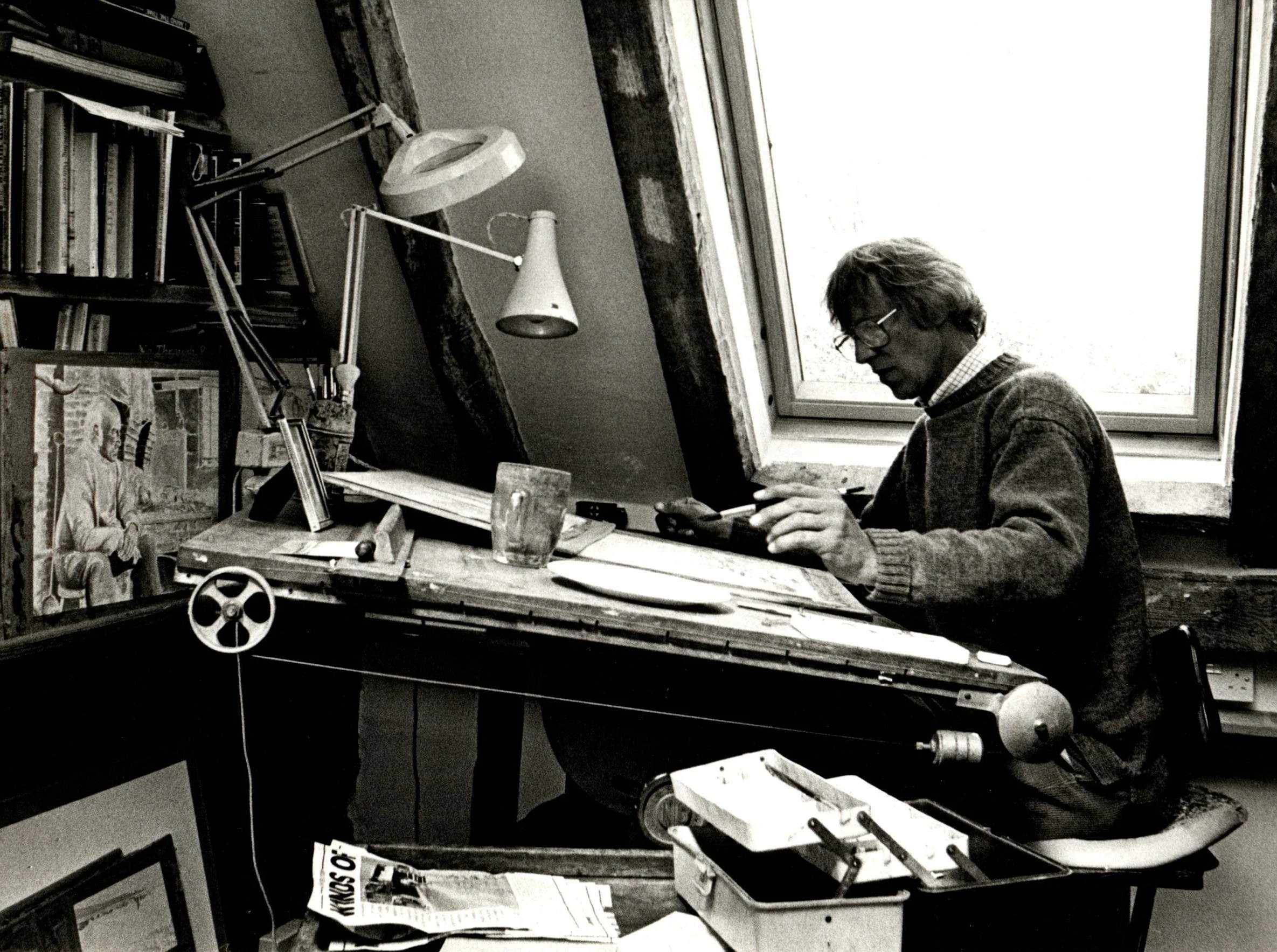
About the artist
John Western (1948–1993)
John was born into a farming family at Bridge Farm in Cretingham. Soon after starting school, he contracted meningitis and it was unclear whether he would survive. He slowly emerged from the crisis, but was left with a legacy of poor eyesight. John started to draw, and his mother saw an emerging talent which she encouraged with help from a local tutor, and a visit to see Leonard Squirrell who would become an inspiration for him.
He went to Ipswich Art School and in 1970 graduated in Graphic Design. In 1970 he came down to London where he had secured a job as a stamp designer with Studio Corot. London life did not really suit John and he returned to his first love of recording old buildings and farm machinery.
Back in Suffolk, John set up studio in a houseboat on the Deben at Woodbridge. The search for a permanent home eventually led him to Ramsey Cottage in Monewden, where he later re-erected an old barn which became his main studio. In 1972 he held his first one-man exhibition at Reade’s Gallery in Aldeburgh.
An important commission followed for 23 full size drawings for Eric Sandon’s Suffolk Houses, A Study of Domestic Architecture, published in 1977. The author acknowledged John’s work:
To John Western I am also indebted not only for his drawings, but also for his patience at bringing out in them the required architectural qualities: his work being of an unusual sensitivity, he has succeeded not only in illustrating Suffolk houses but also in eliciting that special atmosphere of a certain brooding remoteness which I feel is unique to this county.
Further commissions followed, such as for Reader’s Digest AA Book of Country Walks, for which he provided at least a hundred drawings. This was followed by further commissions for many well-known buildings and schools not only in this country but also in North America. A particular honour was a commission by RAF Cranwell for a drawing of the College as an official wedding present to Prince Charles and Diana in 1981.
John’s work up to this time was mainly in his pencil drawings. His influences included the American artist Andrew Wyeth and, nearer to home, Leonard Squirrell. He was now making tentative steps into watercolour. In one of his sketchbooks he noted,
I had for a few years been working largely on commissioned work out of the county, when I realised a number of my favourite subjects were either being demolished/dismantled or just falling down. I made dozens of sketches of the barn [Middle Barn, Framsden], and just as I become familiar with the subject and wrestle with this new medium watercolour, it too came down.
Through hard work, John’s skills developed and he became an excellent watercolour artist, which can be readily seen in his subsequent work. He collaborated with his friend and fellow artist Geoffrey Baverstock. Joint commissions for Dorling Kindersley in 1980 saw John provide some 180 drawings for The Book of Buildings, A Traveller’s Guide. Although the locations were throughout Europe and America, the drawings were all made from photographs supplied by the publishers.
John met Jen in the early 1980s, marking the start of a long relationship. They often visited faraway places exploring their shared interests, including a memorable trip to Italy where he captured well-known views such as the Ponte Vecchio in Florence, the magnificent Duomo and the leaning tower of Pisa. Visits were also made to Dubai where he recorded many pictures of the ancient wind-tower houses which were under threat of demolition. Prince Charles had started a campaign to save them and it was John’s friend Rayner Otter who invited him to come and make the recordings.
In the 1980s John’s volume of work continued to increase, with many exhibitions in Suffolk and further away in London and Jersey. He took an interest in etching, and under the guidance of Jude Lockie in her Framlingham studio, went on to produce many fine etchings. Framlingham was also the focus of much work, with John combining business and pleasure in the Hare and Hounds pub in Double Street. Along with Geoffrey Baverstock, John was a regular there on Monday nights for several years, filling many pages of his sketch books.
Calendars were a regular source of income, starting in the late 60s and every year after, which were were commissioned by companies such as Crane’s of Ipswich, Potter’s of Framlingham and his brother Richard’s trailer business.
In the early 1970s, John Western began a long-standing professional relationship with F. W. Pawsey & Sons, a well-established Suffolk publisher and printer, through Bob Pawsey. Sharing a passion for Suffolk’s heritage, they focused particularly on the River Orwell, the county’s maritime traditions, historic buildings, farmhouses and barns.
Throughout the 1970s and 1980s, Pawsey’s published John Western’s calendars, featuring his detailed depictions of the Suffolk landscape and architecture. They also produced notelets and limited-edition signed prints, bringing his work to a wider audience and preserving his visual record of the Suffolk countryside.
After Johns death Bob Pawsey continued to promote and preserve his work until his own death. His estate generously donated its collection of John Western prints to us, while also acquiring a significant number of Western’s original pencil drawings and watercolours. Together, these works help us preserve and celebrate the legacy of this important Suffolk artist.
A very special thankyou goes out to Emma and Nicola Pawsey who kindly shared so many works of which were saved from Bob Pawseys ex printing works in Ipswich.
An increasing interest in the countryside as seen from the river led him to buy a traditional clinker-built gaff-rigged motorsailer. Much time was spent moored up on a river while he captured these new views. It is fair to say that he was not a natural sailor and there were many mishaps. Now working mainly in watercolours, he held his Three Rivers exhibition in 1986 and later The Suffolk Rivers exhibition at the Ramsholt Arms. This theme continued through his work and in the last calendar of 1993 there is an atmospheric view of Iken Church and the river. His previous calendar included the prophetic words,
Although work on the river series often leads to hazards and misfortune, these are far outweighed by the pleasures of viewing a familiar subject from a new perspective.
In January 1993 we heard the shocking news that John and Kevin Hoey were missing following a boating incident near Kyson Point, Woodbridge. It was a difficult time for everyone, and John’s body was not found for several weeks.
John Day of the East Anglian Traditional Art Centre in Wickham Market kindly prepared a critique of John’s work for me.
As an Art Historian I am forever comparing the work of one artist to another, usually works I am more familiar with. John Western’s paintings remind me partly of past masters, including Thomas Churchyard’s views of the river Deben near Woodbridge, and quite often they have a little of the Leonard Squirrell architectural observation, and sometimes a fair degree of Cavendish Morton’s colour and light.
The pencil drawings are perhaps where John was unique as he had the capacity to record scenes down to the last nail or wood shaving. His interiors, especially the workshops, are where one feels he had a special affinity, and are painstakingly rendered yet retain a degree of ‘Art’ as well as considerable ‘Craft’, which he combines to make up a balanced picture.
We are fortunate everyone has different tastes regarding Art otherwise we would all display similar works in our homes. John Western fits within the ‘Traditional School’ with roots back to the 18th century watercolourists, but it is his accurate observation and occasional flash of modernism which makes him stand out amongst late 20th century East Anglian Artists.
We can only speculate on what might have been had he lived longer. His legacy lives on in the great number of drawings and paintings in Suffolk homes and well beyond.